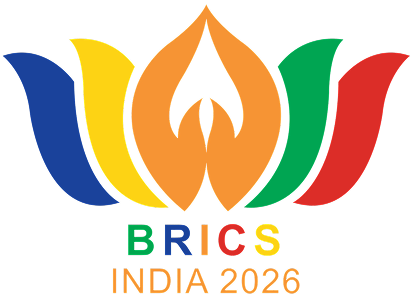
The BRICS logo for India’s Chairship beautifully blends tradition with modernity. The petals radiate the vibrant colors of all BRICS member countries, highlighting their collective strength and unity.
At the centre, the graceful “Namaste” gesture captures India’s timeless spirit of warmth, respect, and harmonious collaboration.
Complementing this visual identity are the three core pillars of BRICS—Political & Security cooperation, Economic & Financial partnership, and People-to-People exchanges—all subtly represented through the logo’s message of inclusivity, dialogue, and shared growth. Together, the design reflects the broader BRICS vision of cooperation, sustainable development, and global harmony.
Building for Resilience, Innovation, Cooperation and Sustainability
India’s BRICS Chairship is guided by the theme “Building for Resilience, Innovation, Cooperation and Sustainability”, reflecting a people-centric and humanity-first approach articulated by the Hon’ble Prime Minister at the 2025 Rio Summit.
Key Pillars for India’s BRICS Chairship
Resilience
Strengthening economic, social, and institutional resilience to navigate global uncertainties, supply chain disruptions, health challenges, and climate risks.
Innovation
Deploying new and emerging technologies such as digital public infrastructure, fintech, AI, and knowledge sharing to enable effective service delivery and future-ready growth.
Cooperation
Deepening multilateral engagement among BRICS members through enhanced policy coordination, development finance, trade facilitation, reforms in global institutional governance, and people- centric partnerships.
Sustainability
Accelerating collective efforts toward climate action, green finance, energy transitions, and sustainable development aligned with national and global priorities.
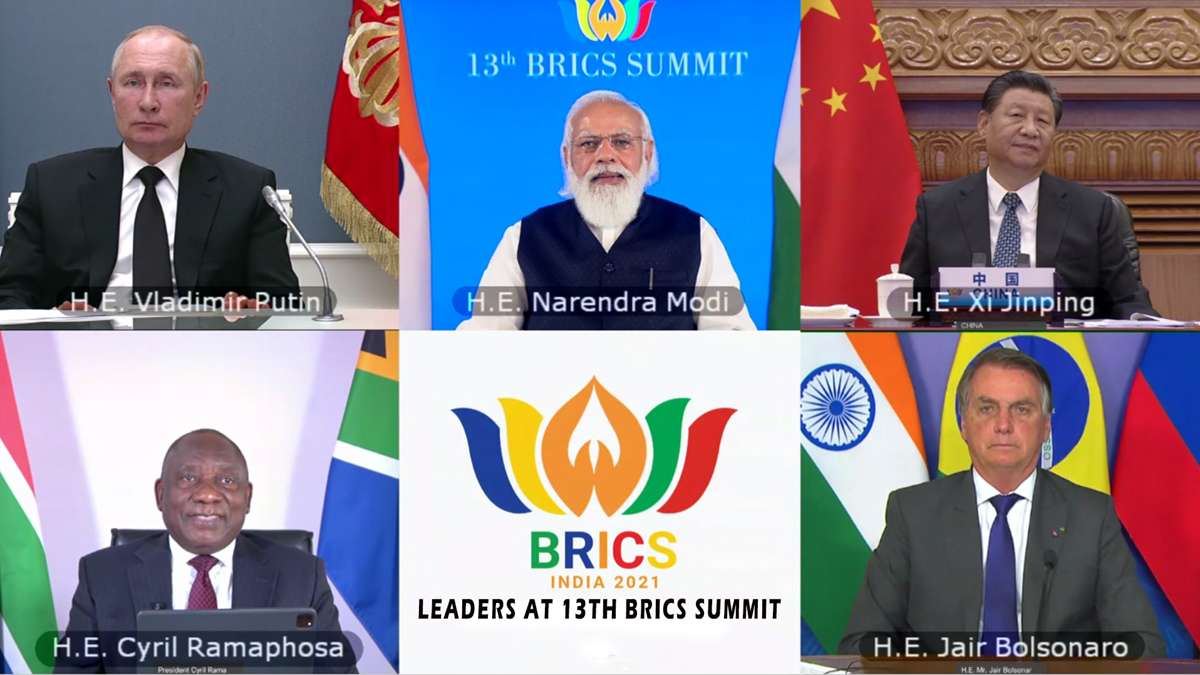
The 13th BRICS Summit was held on 9 September 2021 in New Delhi, India, under the theme “BRICS @ 15: Intra-BRICS Cooperation for Continuity, Consolidation and Consensus.” Leaders adopted the New Delhi Declaration, which marked the 15th anniversary of BRICS and emphasized reform of the multilateral system, counter-terrorism cooperation, harnessing digital tools for achieving the SDGs, and enhancing people-to-people exchanges. India streamlined BRICS’ working methods, making communiqués simpler and more accessible, and introduced new ministerial tracks such as the Digital Health Summit and the inaugural Water Ministers’ Meeting. India also convened the Heads of Space Agencies to sign the BRICS Remote Sensing Satellite Constellation Agreement, advancing cooperation in climate research, agriculture, and disaster management. The declaration included a landmark Joint Statement on Strengthening and Reforming the Multilateral System, acknowledging deficiencies in institutions like the UN Sanctions Committee and calling for comprehensive reforms to make global governance more inclusive, representative, and accountable. Other deliverables included the BRICS Counter-Terrorism Action Plan, the BRICS Customs Mutual Assistance Agreement, and the operationalization of the Agricultural Research Platform. India curated a full calendar of people-to-people events, including the BRICS Film Technology Symposium and workshops on digital forensics.
The 8th summit was held on 15–16 October 2016 in Goa, India. The Goa Declaration and Action Plan, under “Building Responsive, Inclusive and Collective Solutions,” welcomed NDB operationalization and first renewable energy loans; stressed UN reform including the Security Council to enhance developing-country participation; and reaffirmed commitment to Agenda 2030 and SDGs. Leaders prioritized clean and renewable energy access and energy security, and underscored combating HIV and tuberculosis. India placed strong counter-terrorism language on the agenda, pressed for FATF standards, and hosted the BRICS–BIMSTEC Outreach Summit to align South Asian regional priorities in counter-terrorism, trade, energy, investment, environment, technology, infrastructure, and human development. Deliverables included agricultural, customs, and diplomatic academies cooperation. Goa’s blend of development finance, energy transition, health cooperation, and security clarity broadened BRICS’ practical footprint across sectors.
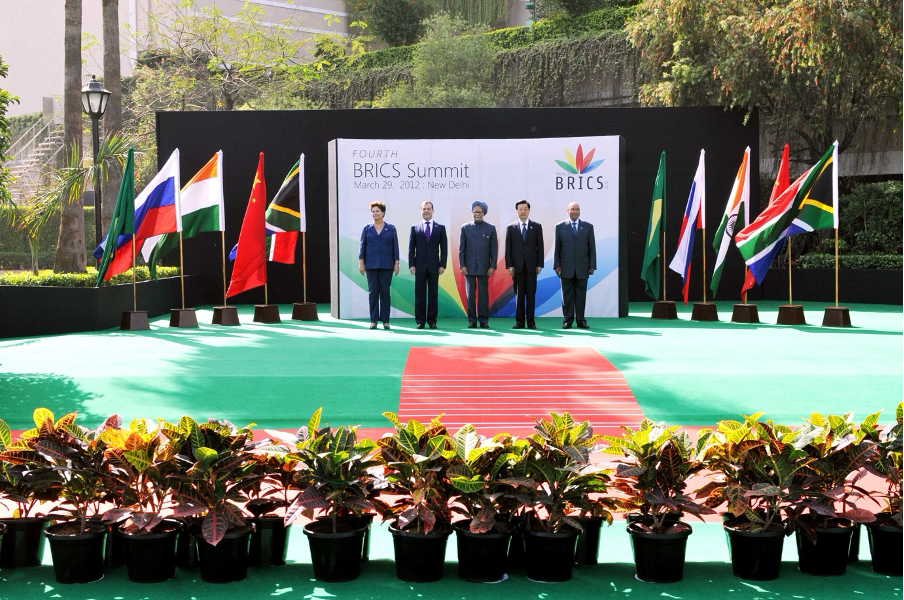
The 4th BRICS Summit was held on 29 March 2012 in New Delhi, India, under the theme “BRICS Partnership for Global Stability, Security and Prosperity.” Leaders adopted the Delhi Declaration, which focused on uneven recovery, sovereign debt risks, and sustainable development ahead of Rio+20. The declaration emphasized poverty eradication, food and energy security, and climate resilience. The outcome document called for IMF quota reform, fairer World Bank representation, and balanced growth. India introduced practical cooperation tracks in agriculture, health, and science, foreshadowing the eventual creation of the New Development Bank (NDB) and Contingent Reserve Arrangement (CRA). India also highlighted terrorism as a global threat, stressing the need for collective action and stronger institutional mechanisms. The Delhi Summit marked a turning point, moving BRICS from consultation on global economic issues to practical cooperation across multiple sectors.